 English
 Français
 Deutsch
Locals call it the "Colosseum of Africa", and once you see it rising over a flat plain of olive groves, you'll understand why. The amphitheater of El Jem is the third largest in the Roman world — after the Colosseum in Rome and the ruined arena of Capua — and the best preserved in all of North Africa. It earned its UNESCO World Heritage status in 1979, and on a busy gladiator day it could seat 35,000 spectators, more than the population of the surrounding modern town. A self-drive day trip is hands-down the best way to visit, giving you the freedom to arrive at sunrise and combine the site with another coastal stop on the way back.
1. How to Get to El Jem
El Jem sits squarely in the Tunisian Sahel, midway between Sousse and Sfax, just off the A1 motorway. Most travelers come from one of four launching points — and all of them are within easy half-day driving range.
- From Sousse — 65 km straight down the A1, about one hour. The easiest base for a day trip. Pick up your car from our Sousse car rental branch and you'll be there before the morning sun gets harsh.
- From Monastir — 80 km via the C82 and A1, roughly 1 hour 10 minutes. A scenic option through olive groves and salt marshes. Our Monastir car rental service can hand the car over at the airport or in the medina.
- From Tunis — 200 km via the A1 motorway, around 2 hours nonstop. The drive itself is unremarkable, but if you start at 7am you'll be inside the amphitheater before the tour buses arrive. Troisa covers Tunis pickup with free delivery in the metro area.
- From Enfidha airport — 100 km, 1 hour 15 minutes. If you're flying into Enfidha-Hammamet, our Enfidha airport car rental desk lets you start the day trip without backtracking to a city first.
2. What to See Inside the Amphitheater
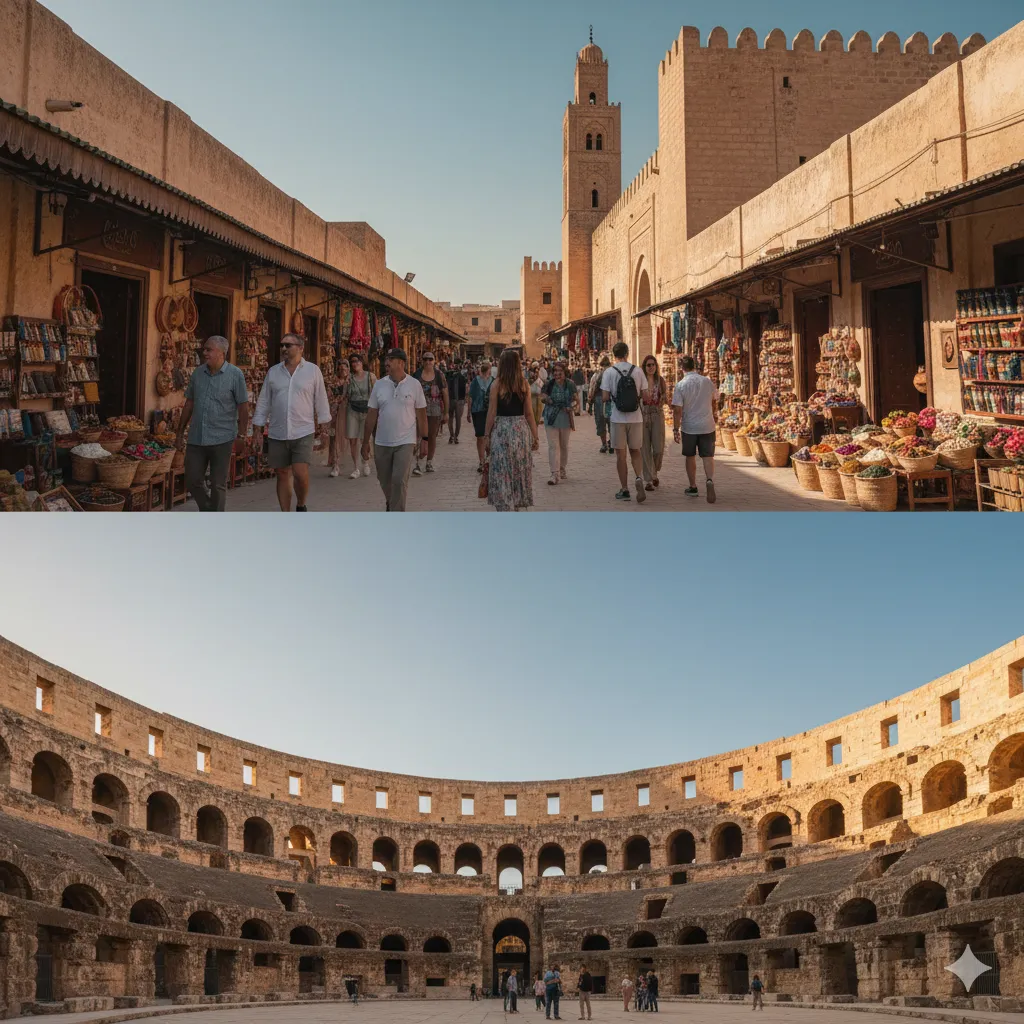
The first impression is the sheer scale. The outer wall still stands 36 meters tall in places — three arched tiers of honey-colored limestone quarried just outside town. Walk a slow loop around the perimeter before entering; the south side took a beating from Ottoman cannon fire in the 17th century, and the missing chunk gives you a sense of the engineering inside.
Once you're through the ticket gate, drop straight down into the underground passages. This is where gladiators, prisoners and wild animals were kept before being hauled up to the arena floor on wooden lifts. The corridors are cool, claustrophobic and genuinely atmospheric — you can run your hand along grooves cut into the stone walls 1,800 years ago.
Climb back up to the arena floor, then keep climbing to the top tier. The views over the rooftops of modern El Jem and the surrounding olive plain are unmatched, and the higher seats are where you'll get that iconic photograph of the curved corridors disappearing into the distance.
"Few Roman monuments anywhere in the Empire have aged this well. Standing on the top tier at El Jem feels closer to a 3rd-century afternoon than a modern museum visit."
3. El Jem Archaeological Museum
A ten-minute walk south of the amphitheater sits one of the most underrated museums in Tunisia. The El Jem Archaeological Museum is built around a reconstructed Roman villa and houses one of the country's finest mosaic collections — second only to Bardo. The Triumph of Bacchus, the Nine Muses and a striking polychrome scene of Orpheus charming wild animals are all here.
The ticket is separate from the amphitheater (very inexpensive) and absolutely worth the extra forty-five minutes. Behind the museum, the in-situ remains of two more Roman houses give context — you'll never see another mosaic floor and forget that it was once someone's living room.
4. Combining El Jem with Other Sites
El Jem itself takes about three hours including the museum. That leaves plenty of road time for one of three obvious add-ons:
- Mahdia (45 km east, 1 hour) — a coastal Fatimid old town on a peninsula jutting into the sea. Quieter than Sousse, with the best fish lunch on this stretch of coast.
- Kairouan (90 km west, 1 hour) — the Great Mosque of Uqba and the Aghlabid Basins. If you're going to do both UNESCO sites in one shot, look at our Kairouan and El Jem UNESCO day trip with driver-guide.
- Sousse Medina (65 km north, 1 hour) — the ribat, the Great Mosque and the museum in the Kasbah make a perfect afternoon to bookend a morning at El Jem.
5. Practical Tips
Pro Tips for Visiting El Jem
- Opening hours: 8am-7pm in summer, 8am-5:30pm in winter. Arrive at opening or after 4pm to dodge the heat and tour groups.
- Ticket price: Around 12 TND for the amphitheater, 8 TND for the museum (check before travel — prices are revised periodically).
- Best photo angle: Outside, from the southwest corner just before golden hour. Inside, the upper tier looking down across the arena floor.
- Hot midday warning: The limestone radiates heat. In June-August, midday on the upper tier can pass 45°C — bring water, a hat and sunscreen.
- July highlight: The annual El Jem Symphonic Festival turns the arena into a concert venue. Book tickets months ahead.
6. Where to Eat
El Jem is a small town and food choices are limited, but two reliable spots sit within five minutes of the site. Restaurant Le Bonheur serves classic Tunisian grills — merguez, lamb chops, fresh harissa — in a shaded courtyard, ideal after a hot morning on the upper tier. Restaurant Olympia is the more polished option, with a fuller menu of fish, couscous and Tunisian salads, plus a small terrace overlooking the side of the amphitheater. Don't expect haute cuisine; expect honest plates and very reasonable bills.
If you'd rather save your appetite for the coast, the seafood in Mahdia or Sousse is in another league.
7. Renting a Car for El Jem
Group tours to El Jem exist, but they almost always rush you. You'll arrive at the busiest hour, get an hour inside, skip the museum, and be back on the bus before you've finished thinking. Self-drive solves all of that. With a car you control the timing, the pace and the combinations — sunrise photos before the buses arrive, lunch in Mahdia by the sea, an unhurried museum visit on the way back.
For a useful primer on local rules of the road, our driving in Tunisia guide covers everything from roundabout etiquette to A1 toll booths. When you're ready, browse our fleet — a compact city car handles the A1 easily, and we drop off at any Sahel airport or hotel. Our Sousse and Monastir branches are the most convenient bases for a day trip to El Jem.
One day, two UNESCO-level monuments, and the sense of having stood in a place where 35,000 Romans once roared at the same time. Few destinations in the Mediterranean offer that.
Leila Gara
Leila is a Tunis-based historian and travel writer specializing in Tunisia's Roman, Byzantine and Phoenician heritage.