 English
 Français
 Deutsch
Homer wrote about it three thousand years ago. He called it the Land of the Lotus-Eaters — the island so sweet that Odysseus' crew refused to leave. They were talking about Djerba, the 514 km² scrap of palm-shaded coastline off Tunisia's southern shore. Modern visitors don't need the lotus fruit; the white-washed villages, ochre dunes, ancient synagogues and Mediterranean beaches do the job all by themselves. The best way to taste the whole island is by car — distances are short, the coastal road loops are scenic, and taxis here are scarce and notoriously expensive.
1. Getting to Djerba
There are three ways onto the island, and each has a personality:
- By air — Djerba-Zarzis International Airport (DJE) is the simplest option, with seasonal direct flights from Paris, Brussels, Frankfurt and a handful of charter hubs. Pick up your car at arrivals through our Djerba airport car rental desk and you can be at your hotel inside half an hour.
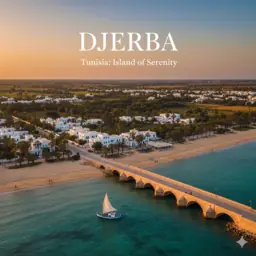
- Roman causeway from Zarzis — A 7-km stone causeway, originally laid by the Romans and still in service, connects the southeast of the island to the mainland near El Kantara. If you're road-tripping down from Tunis, this is the dramatic way to arrive.
- Ferry from Jorf — A short, cheap car ferry crosses from Jorf on the mainland to Ajim in the west of the island. The crossing takes about 15 minutes and runs frequently, but queues stretch on summer weekends.
Already on the island? Our Djerba car rental branch delivers to any hotel from Houmt Souk to the beach resorts in the east — no need to take a taxi to a depot.
2. Houmt Souk — The Beating Heart
Houmt Souk ("market quarter" in Arabic) is the island's capital and the place you'll keep coming back to. It feels half Greek-island village and half Saharan town, with low whitewashed cubes, blue shutters and narrow lanes that open into shaded courtyards where merchants drink coffee and barter with regulars.
The covered souks are organized by trade — the jewelers' souk sells the heavy filigreed silver of Berber Djerba, the fish market auctions the morning's catch (a daily piece of theater you should not miss), and the small spice and basket souks are wonderful for souvenirs that don't feel airport-bought. Park outside the old town walls and explore on foot; the lanes are too narrow for comfortable driving.
3. El Ghriba Synagogue
Tucked into the village of Erriadh, fifteen minutes south of Houmt Souk, sits one of the most extraordinary religious buildings in the Mediterranean. El Ghriba is widely considered the oldest functioning synagogue in Africa — local tradition says it was founded in 586 BCE by priests fleeing the destruction of the First Temple in Jerusalem, who brought a stone from the temple itself.
Step inside and you'll find a low-ceilinged hall of blue Tunisian tilework, hanging brass lamps and centuries-old Torah scrolls. Every spring, on the 33rd day after Passover, the synagogue hosts the Lag Ba'Omer pilgrimage, drawing the worldwide Djerban Jewish diaspora back to the island. Modest dress is expected; men are given a kippah at the entrance.
"El Ghriba is one of the few places in the world where layers of history don't compete — they coexist. Punic stones, Roman columns, Tunisian tile, all still in use."
4. Beaches Worth Driving To
The east coast of Djerba is one long ribbon of pale sand and shallow turquoise water. The big resort beaches around Zone Touristique have all the loungers and parasols you'd expect, but rent a car and you can find quieter sand within twenty minutes.
- Sidi Mahrez — The classic Djerba beach: wide, white, gently shelving. The northeast resorts cluster here, but a five-minute walk in either direction empties the crowd.
- Aghir — Further south, with calmer water and a younger, more local crowd. A good lunch stop at one of the simple seafood shacks.
- Seguia — At the southeast tip of the island, this is where you go for the wide-horizon photos: nothing but dunes, sea and the occasional flamingo.
5. Star Wars in Djerba
George Lucas filmed parts of A New Hope here in 1976, and the locations have aged surprisingly well. The fishing village of Ajim, in the west of the island, was the exterior for the Mos Eisley spaceport. The Cantina has been rebuilt as a restaurant; the small white building where Obi-Wan first meets Luke is still standing, half-forgotten on a quiet back street.
If you want the curated tour with the rest of the Tatooine sites on the mainland — Sidi Driss, Ksar Hadada, the canyon of Matmata — book our private Star Wars Tunisia tour, which combines Djerba and the southern desert in a single guided experience.
6. Djerba Heritage Museum and Erriadh Street Art
Right next to El Ghriba, the village of Erriadh has reinvented itself as one of the most exciting open-air galleries in the Arab world. In 2014, the Djerbahood project invited 150 international street artists to paint the village. The result is more than 250 murals wrapped around doorways, garage shutters, courtyards and entire facades — and they keep being added to.
Allow at least two hours to wander, then drive seven minutes back toward the coast to the Djerba Heritage Museum in Guellala, a small but well-curated collection of traditional Djerban costumes, jewelry, marriage rituals and the famous local pottery.
7. Where to Stay
Djerba accommodates every style of traveler:
- Dar Dhiafa (Erriadh) — A boutique hotel carved out of seven interconnected traditional houses, with whitewashed courtyards, a tiny pool and an excellent in-house restaurant. The best base if you want character over beach.
- Radisson Blu Palace Resort & Thalasso (Sidi Mahrez) — A reliable five-star on the eastern beach, with one of the best spas on the island and direct access to the long sand strip.
- Mövenpick Resort & Marine Spa — Quieter, more family-friendly, with shaded gardens and excellent breakfast — popular with European repeat visitors.
- Dar Bibine — A small guesthouse near El Ghriba run by a French-Tunisian couple. Five rooms, home cooking, a courtyard that locals call the prettiest in Erriadh.
8. Best Local Food
Djerba's kitchen is its own thing — heavier on seafood and lighter on harissa than the mainland, with strong Berber and Jewish influences:
- Couscous au poulpe — Octopus couscous, the Djerban specialty, slow-cooked in a tomato-and-pepper sauce until the octopus is meltingly tender.
- Ojja — A spicy egg-and-tomato pan stew often served with merguez or shrimp. The Djerban version uses local sun-dried tomatoes and is worth getting up early for.
- Brik — The Tunisian filo-pastry parcel of egg, tuna and capers, served everywhere but particularly good in the small lunch spots around Houmt Souk fish market.
- Mloukhia — A dark green stew of jute leaves slow-cooked with beef. An acquired look, an unforgettable taste.
Pro Tips for Djerba
- Drive on the right: Roads are flat and well-paved, but watch for free-roaming sheep and donkey carts on village stretches.
- Fill up early: Petrol stations cluster around Houmt Souk and the airport — top up before driving the southern loop.
- Friday market: The weekly market in Houmt Souk is the cultural highlight of any Djerba visit — go early, leave the car outside the old town.
- Cash for villages: Cards are accepted in resorts and bigger restaurants, but villages run on dinars only.
9. Day Trips from Djerba
The island sits within striking distance of some of Tunisia's most cinematic southern landscapes. Cross the Roman causeway and within an hour and fifteen minutes you'll reach Matmata, the famous troglodyte village of underground Berber homes — including the one used as the Skywalker family farm in Star Wars. For a deeper dive, our private Matmata Berber explorer tour includes a local lunch inside a working troglodyte home.
Further west, Tozeur (3 h 30) opens the gateway to the Sahara — date-palm oases, the Chott el Djerid salt flats, and the Star Wars sets of Mos Espa and Lars Homestead. It's a long drive but doable as an overnight, and the southern road is genuinely scenic.
10. Why Self-Drive in Djerba
Djerba is small enough that you'll want to see most of it, and big enough that walking and cycling won't get you between the spots that matter. Public transport is limited — the few buses connect Houmt Souk with the resort strip and not much else — and the island's taxis are scarce, especially after dark and outside the main town. A car solves all of that for a fraction of what a week of taxis would cost.
Distances are short (the entire perimeter loop is roughly 90 km), the roads are flat and well signposted, and the coastal route between sights is one of the prettiest drives in Tunisia. For local rules and tips, see our driving in Tunisia guide.
When you're ready, browse our fleet for compact cars and family SUVs suited to island travel. Our Djerba car rental branch delivers free of charge to any island hotel, and Djerba airport pickup hands you the keys at arrivals. If you'd rather skip the wheel for the airport leg, our private transfer service covers it.
Homer's lotus-eaters had it right. Djerba is the kind of place that puts a hand on your shoulder and quietly suggests you stay another day. With a car parked outside, that becomes very easy to do.
Leila Gara
Leila is a Tunis-based historian and travel writer specializing in Tunisia's Roman, Byzantine and Phoenician heritage.