 English
 Français
 Deutsch
Seven days is the sweet spot for Tunisia. A weekend barely cracks the surface; two weeks risks repetition. In one carefully planned week you can loop roughly 1,300 kilometres, tick off four UNESCO World Heritage sites, sleep in three completely different climate zones, and still have an afternoon spare to drink mint tea on a sunlit terrace. The catch: it only works if you have your own wheels. Group tours bury you on a bus from sunrise to sunset; resort-based day trips force you to pick between Carthage or the Sahara. A self-drive splits the difference and gives you the best of both.
This itinerary is the exact route we recommend to Troisa customers who ask "if I had one week, what would you do?" — refined over hundreds of conversations at the pickup counter. Every drive is honest (no padded "1.5 hour" segments that take three), every stop earns its slot, and every hotel zone has Troisa coverage if you need to swap cars or extend. Start at our fleet page to lock a vehicle, then skim our broader driving in Tunisia primer before you arrive.
Day 1 — Land at Tunis-Carthage and Settle In
Most international flights land at Tunis-Carthage in the late morning or early afternoon. Don't burn day one on a long drive — keep things tight and recover from the flight. We strongly recommend collecting your car directly at the terminal with our Tunis-Carthage airport pickup service: an agent meets you in arrivals, paperwork takes five minutes, and you're out of the airport before the queue at the taxi rank has even moved.
From the airport, head straight to your base for the next two nights. Our preference is La Marsa or Sidi Bou Said — both are coastal, both are 25 minutes from the terminal, and both put you a short drive from the Carthage ruins you'll explore on day two. Drop your bags, then walk the corniche promenade in La Marsa as the light softens. For dinner, drive 4 km north along the cliffs to Sidi Bou Said — book ahead at Dar Zarrouk or grab a table at any of the simpler grills inside the blue-and-white village. You'll want to be in bed early; tomorrow is the longest sightseeing day of the week.
Day 2 — Tunis Medina + Carthage UNESCO Ruins
Begin at the Bardo National Museum on the western edge of Tunis. Allow at least two hours — the Roman mosaic collection is the finest on earth and you can move at your own pace without a tour guide rushing you. Park in the museum's secure lot to avoid hunting for street parking in a city you don't yet know.
From the Bardo, drive 15 minutes east to the medina. Park outside the walls near Bab el Bhar and walk in. Lose yourself for two hours: the souks of perfumes, copper, and books are still working markets, not theatre. Our standalone guide on exploring the souks of Tunis has a map of which alleys lead where and how not to overpay.
Lunch at Restaurant Dar el Jeld inside the medina (book a day ahead), then drive 25 minutes north-east to the Carthage archaeological park. The Byrsa Hill, Antonine Baths, and Roman theatre are the three sites worth your time; the museum is closed for renovation through late 2026. If you'd rather skip the navigating and have an expert do the storytelling, our private Carthage & Sidi Bou Said tour covers the same ground with a licensed guide. Sleep again in La Marsa, or drive 65 km south to Hammamet to shorten tomorrow's first leg.

Day 3 — Hammamet → Sousse → Monastir Coast
Day three is a Mediterranean parade. Begin with a beach morning in Hammamet — the old medina sits literally on the sand, and a coffee at one of the small cafés inside the kasbah walls beats any resort buffet. After 11 am, point south.
Quick stop in Nabeul for hand-painted pottery (ten minutes off the motorway, and the prices in the workshops on Avenue Hedi Chaker are half what you'll see in tourist shops elsewhere). Then take the A1 south to Sousse. The medina here is smaller than Tunis but more relaxed, and the Ribat fortress climbs to a watchtower with a postcard view over the Bay of Hammamet. Skip Port El Kantaoui's marina unless you have kids — it's a manufactured tourist strip.
Continue 20 km further to Monastir for sunset at the Ribat (the location used in Monty Python's Life of Brian). Sleep in Monastir or push another 35 km to Mahdia, which is quieter and has the best fish restaurants on the coast.
Day 4 — El Jem Amphitheater + Drive South to Tozeur
Wake early. Today is the transition day from coast to desert and it includes the longest single drive of the trip. First stop: El Jem, an hour south of Monastir. The Roman amphitheatre rising out of the modern town is genuinely jaw-dropping — better preserved than the Colosseum in Rome and a fraction as crowded. Go straight when the gates open at 8 am, allow 90 minutes, then have a coffee at the small museum café opposite. Our deeper read on the site is in the El Jem day-trip guide.
From El Jem, drive west via the Sfax bypass and pick up the A1 south. The road quality stays excellent all the way to Gafsa. After Gafsa it becomes the P3 — still paved, still safe, but two-lane with truck traffic. Reach Tozeur by late afternoon and check into a dar (a traditional courtyard guesthouse) inside the old town. Dar HI and Dar Anebar are our usual recommendations; both have parking inside the gates.
Pro Tip — Fuel Strategy South of Sfax
- Top up in Sfax or Gabès. Stations are noticeably sparser between Gafsa and Tozeur, and the few that exist sometimes run dry on Fridays.
- Carry 4 litres of water in the boot. The afternoon heat between Sfax and Gafsa pushes engine temperatures up; passengers and radiators both need a buffer.
- Plan to arrive before dusk. Camels and donkeys wander onto the P3 after dark and reflective markings vanish.
Day 5 — Tozeur Mountain Oases + Star Wars Locations
This is the most photogenic day of the entire trip. In the morning, loop the three mountain oases west of Tozeur: Chebika (a clifftop waterfall feeding palm groves), Tamerza (a deserted Berber village with a canyon), and Mides (an even narrower canyon used in The English Patient). The loop is signposted and well-paved; a saloon car handles it fine outside of rain.
After lunch back in Tozeur, drive north-east to Ong Jemel and the abandoned Mos Espa set from The Phantom Menace. The structures are still standing, half-swallowed by drifting sand, and you'll often have the place to yourself. The track in needs an SUV in some seasons — if you'd rather not commit, our private Star Wars Tunisia tour covers Mos Espa plus several other sets in a single day with a driver who knows the routes.
End the day at the eastern edge of the Chott el Djerid salt flat for sunset. Park at the small lay-by where the causeway begins and walk out onto the crust as the light turns pink. Sleep in Tozeur, or shift base east to Douz if you want to start day six closer to Matmata.
"Standing on the salt flat as the sun drops behind the dunes, you understand why every cinematographer who comes here ends up shooting another film. The colour palette doesn't exist anywhere else."
Day 6 — Matmata Berber Country + Drive to Djerba
Start with the troglodyte houses of Matmata — pit dwellings carved straight down into the rock, still inhabited, and famously the home of Luke Skywalker's family in the original Star Wars. The Hotel Sidi Driss is the actual Lars homestead and still rents rooms. Visit one of the private homes that opens to guests for mint tea (about 5 TND per person, perfectly fair) and you'll learn more in 20 minutes than any guidebook offers. For the full cultural deep-dive, our private Matmata Berber explorer tour pairs the village with the lesser-known ksour around Tataouine.
By 1 pm, point east. Drive via Medenine to the Djerba causeway at Zarzis — the same Roman-era road bed Hannibal's elephants used, give or take a few resurfacings. Cross onto the island and check in around your Djerba hotel. If you're flying out of Djerba tomorrow rather than driving back, our Djerba airport car rental page explains how to drop the car at DJE without paying a one-way fee.
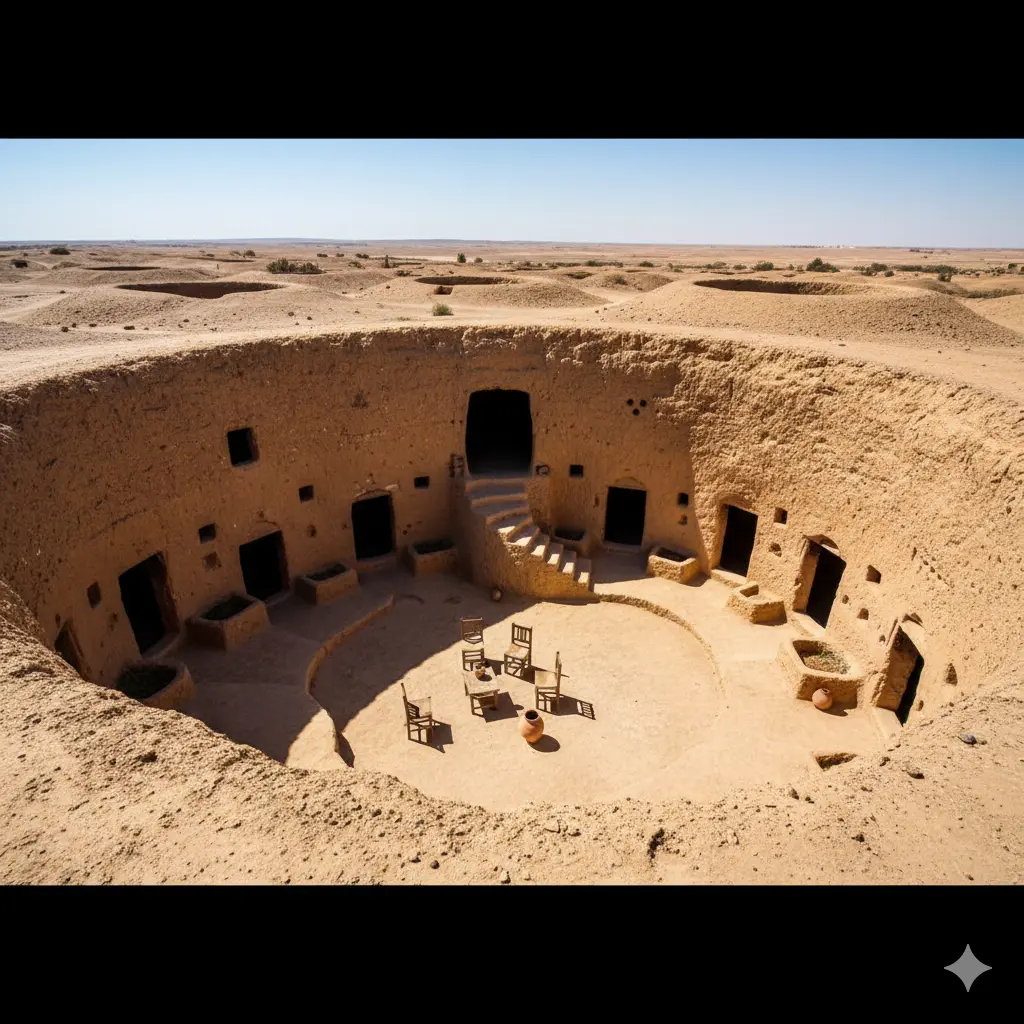
Day 7 — Djerba Island + Return Drive (or Fly Out)
Slow morning on the island. Start in Houmt Souk, the main market town, for the daily fish auction and the central caravanserai (now a row of cafés and craft shops). Drive 22 km south to the El Ghriba synagogue, one of the oldest in Africa and still active. Our companion piece on unwinding in Djerba walks through the village circuit and the best beaches on the south coast.
From here you have two clean options:
- Option A — Drive back to Tunis. 520 km, a full day on the road. Best if your return flight is the next day and you want to keep the rental simple. Use the A1 motorway for speed; don't try to detour.
- Option B — Fly out of Djerba-Zarzis (DJE). Tunisair, Nouvelair and several European charters fly DJE direct. Hand the car back to a Troisa agent at the terminal — see our one-way car rental page for the small drop-off fee, which is often less than the fuel you'd burn driving back.
Which Car Should You Rent for This Itinerary?
The right vehicle depends on how many people you are and whether you plan to leave the asphalt at all.
- Solo or couple, no off-road: an economy car works, but luggage space is tight if you bring a full suitcase each.
- Couple or small family of three: a compact is the sweet spot — enough boot space for three weekend bags, comfortable on the long Sfax-Tozeur leg, and the cheapest fuel bill of any class with air-con.
- Family of four or anyone tempted by dune tracks: book an SUV. The Ong Jemel track to Mos Espa is the obvious payoff, but you'll also appreciate the higher seating position on the long inland stretches.
- Don't drive stick: filter for automatic transmission — about 30% of our fleet is automatic and demand spikes in summer, so book early.
Compare the full lineup on the Troisa fleet page; every listing shows live availability for your dates.
Costs Breakdown for 7 Days
Here are realistic 2026 numbers for two adults sharing, mid-range comfort, eating in good local restaurants but not at five-star hotels.
- Car rental (1 week, compact): ~700 TND / ~210 EUR
- Fuel (1,300 km, diesel): ~145 TND
- Hotels (6 nights, mid-range): ~900 TND
- Food & attractions: ~500 TND
- Total per person sharing: ~2,300 TND / ~690 EUR
That's a comparable European road-trip experience at roughly a third of the cost of the same trip in Spain or Portugal. If you'd rather strip costs further, swap two of the mid-range hotels for guesthouses (drop ~250 TND) and stick to the economy car class.
Common Variants of This 7-Day Loop
The structure above is what we'd call "balanced." Tweak it to fit your interests:
- Beach-heavy variant. Skip Tozeur and Matmata; spend days four and five in Tabarka instead. You trade desert for cork forests and northern beaches — different country, same week.
- History-heavy variant. Add a full day for Dougga between days two and three. Dougga is arguably better than Carthage but takes the entire day from Tunis and back.
- Family variant. Compress the Sahara to a single day (Tozeur only, no Matmata) and slot in two extra pool days in Hammamet. Kids hit a wall by day five otherwise.
Booking & Pickup Tips
A handful of small decisions made before you fly will determine how smooth this trip actually feels:
- Book the car at least four weeks out if you're travelling June through August. SUVs and automatics in particular sell through fast.
- Choose hotel delivery for legs 3 and 4. Our free hotel delivery covers Hammamet, Sousse, Monastir, Tozeur and Djerba — handy if you'd rather start fresh from a different base on a specific morning.
- Save the WhatsApp line. Our 24/7 number lives on the rental folder; in seven days something almost always comes up (a missed turn, a parking question) and a 30-second message beats fumbling with phone menus.
- Don't forget the IDP. A few border-area checkpoints will ask. Painless if you have it; awkward if you don't. The basics are covered in our 5 essential rental tips.
Done right, this is the trip people remember for years. Three climate zones, four UNESCO sites, the Sahara at sunset and the Mediterranean for breakfast — all without ever boarding a tour bus. The hard part is the planning, and you've just outsourced most of it to this page.
When you're ready, lock the car at our fleet listing and ping us via the contact page if you want a route review before you fly. A real Tunisian agent replies in minutes — in English, French or Arabic — and we'll catch the small things you can't see from a screen.
Aymen Ben Salah
Aymen has been exploring Tunisia for over a decade, with a passion for uncovering hidden roads and authentic local experiences.